

“It happens that the three stages of life, youth, maturity and old age, are actually two: the stage in which we consciously distance ourselves from our roots, and the stage in which, consciously or unconsciously, we return to them”.
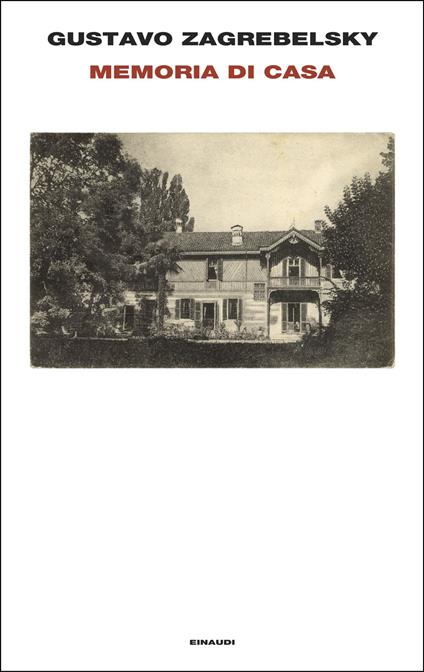
In a villa in the Piedmont countryside that resembles a Russian dacha, and is both a home of illusions and disillusions, a family gathers to reminisce about times and people that are no longer there. Above all, Jean and Lisín, who meet and fall in love in Sanremo in the 1920s. He, charming and tormented, will always remain an “émigré” grappling with his “dark days”. She, stubborn and wise, with strong Waldensian roots, will spend her whole life trying to untangle the knots. But “remembering” is not simply recalling. It is giving life to those who have lost it, rejoicing, grieving, apologising when necessary. It is trying to understand, without judging.
When the Zagrebelsky brothers are summoned by their daughters to the family home, the aim is to retrace lost time, exchange anecdotes and strengthen a common bond. Holidays by the sea with their grandfather dressed in linen, car journeys and his rather unorthodox driving, ice cream cones and sticky hands, nights in bed with their grandmother to overcome their fear of the dark. But for those approaching old age, these memories are details of a larger picture, which perhaps today can be reconstructed by finally asking the questions avoided in youth. It is the third brother, Gustavo, the only one to bear a name linked to the maternal branch of the family, who takes on the responsibility of telling the story, starting not only from a distant time, but also from faraway lands and events. This is because Jean and Lisín – his father and mother – have behind them the stories of two minorities that are in many ways opposites: on the one hand, the Russian exiles, for whom equality had been their downfall, and on the other, the Waldensians, for whom equality had been their achievement. Surprised by the outbreak of the First World War while on holiday in Nice, the Zagrebelskys (including the author's father, who was just five years old at the time) never returned home, and in a two-room flat in Sanremo, overlooking vegetable gardens and the gasometer, they cultivated nostalgia for their country of origin and regret for their lost privileges.
It was there that in 1926 Jean met Lisín, sweet and strong-willed, the daughter of a Waldensian who was so devoted to his work that even his tomb bears the title of engineer. Like different waters flowing into the same river, Jean and Lisín's characters run parallel, on two different levels. He is always convinced that storms come as a surprise and that one must be ready to weather the storm. She, on the other hand, is sure that life is a ball of yarn to be untangled, always able to look beyond, because everything “passes”. If it was not difficult for their children and grandchildren to choose which side to take in life, this “critical recapitulation” becomes an opportunity to understand more deeply, and with more affection, the figure of a father who was perhaps not “uprooted” but certainly “disoriented”, who despite his Italian passport will remain stateless forever, even within his own family.