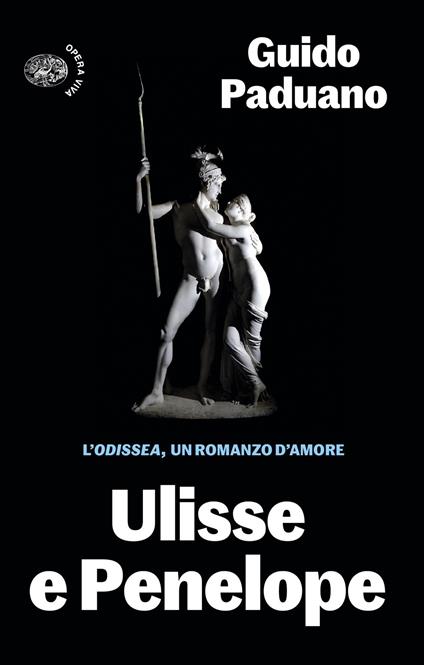
Strong and poised, capable of keeping the suitors at bay for twenty years by “weaving” a web of clever and relentless strategic decisions: this is how Penelope appears in Nolan’s film adaptation of *The Odyssey*. A Hollywood invention? Far from it.
This is confirmed by one of Italy’s most esteemed classical scholars, a translator from Greek and Latin, Guido Paduano.
Contrary to the common view that regards the Homeric epics as documentation of a civilization based on the subordination of women, Paduano demonstrates that the relationship between Odysseus and Penelope is one between equals.
And that the foundational structure of the Odyssey consists of a great love story, whose pillars are the long separation—painful for both Penelope and Odysseus—and the exhilarating experience of their reunion. Penelope speaks of a tremendous pain that “always tears at the heart within her chest”; Ulysses, for her sake, renounces the immortality and eternal youth offered to him by Calypso.
And so, the dominant ideological framework governing gender relations in the Odyssey implicitly contrasts with the poem’s central event: Penelope’s persistent assertion of her own dignity and autonomy. The queen, a woman on her own, manages to rule her Ithaca for twenty years and to resist the advances of over a hundred suitors, enacting a form of resistance exemplified by the cunning of the tapestry—woven by day and unraveled by night—a powerful symbol of her unyielding capacity for action.
But that’s not all. Song after song, it becomes increasingly clear that Penelope is by no means a pale figure in the hero’s shadow, but rather a counterpart to Odysseus—a counterpart capable of standing up to him and even prevailing, forcefully demonstrating her individuality.